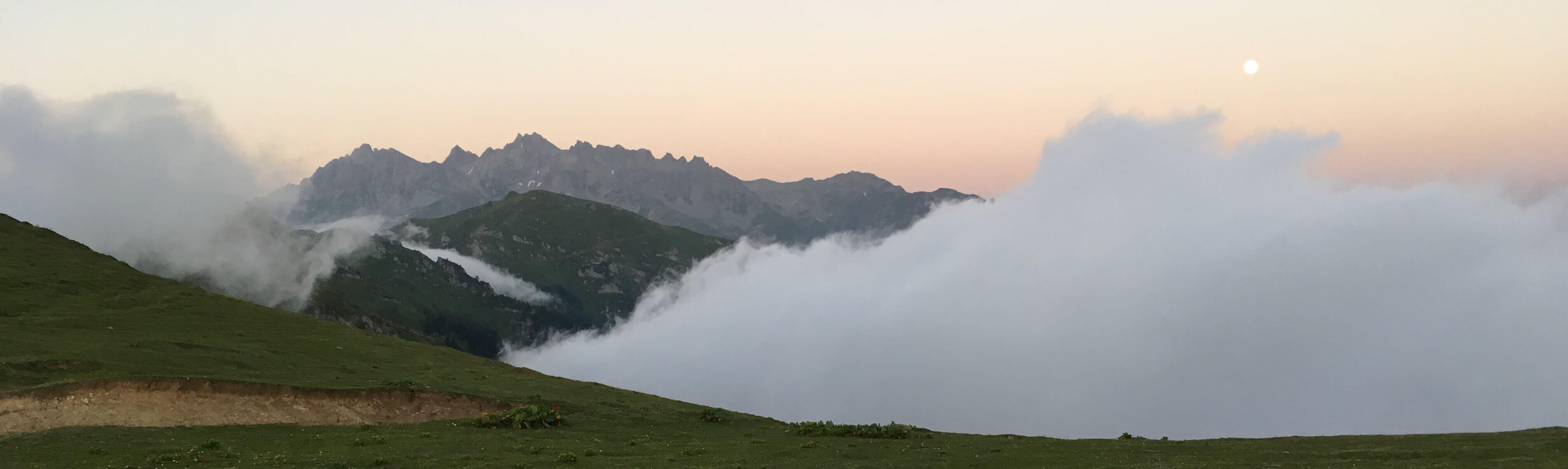
1Blow ye the trumpet in Zion, and sound an alarm in my holy mountain: let all the inhabitants of the land tremble: for the day of the LORD cometh, for it is nigh at hand; 2a day of darkness and of gloominess, a day of clouds and of thick darkness, as the morning spread upon the mountains: a great people and a strong; there hath not been ever the like, neither shall be any more after it, even to the years of many generations.
Joel is describing an imminent attack on Jerusalem. A warning trumpet is to be blown in Zion. The darkness speaks of God’s impending judgment on the city. A great, strong people are spread like the first glints of daylight on the tops of the mountains, ready to attack. Joel is speaking of the future “day of the LORD,” in continuation of this topic from chapter 1. Clearly, if the alarm is yet to be sounded in Jerusalem, the attack spoken of was yet future at the time of Joel’s writing.
According to verse 2, the day spoken of will be unprecedented in all the history of Israel as a time of attack and destruction, and there will be no other day so terrible afterward. This is not an invasion of insects. In Ezekiel 38:8-9, God addressed a leader named “Gog” who would lead an attack on Israel:
“After many days thou shalt be visited: in the latter years thou shalt come into the land that is brought back from the sword, and is gathered out of many people, against the mountains of Israel, which have been always waste: but it is brought forth out of the nations, and they shall dwell safely all of them. Thou shalt ascend and come like a storm, thou shalt be like a cloud to cover the land, thou, and all thy bands, and many people with thee” (Ezekiel 38:8-9).
This attack will take place in the middle of the coming seven-year Tribulation period, after Israel has become comfortable in a false security based on erroneous trust in the Antichrist. In the same chapter of Ezekiel, God confirms that this attack is the one spoken of by the earlier prophets:
“Thus saith the Lord GOD; Art thou he of whom I have spoken in old time by my servants the prophets of Israel, which prophesied in those days many years that I would bring thee against them?” (Ezekiel 38:17). Clearly, this question expects a positive answer.
Ezekiel 38 explains that this attack will be followed by God’s judgment on the attackers, climaxing at the end of the seven-year Tribulation period.
3A fire devoureth before them; and behind them a flame burneth: the land is as the garden of Eden before them, and behind them a desolate wilderness; yea, and nothing shall escape them. 4The appearance of them is as the appearance of horses; and as horsemen, so shall they run. 5Like the noise of chariots on the tops of mountains shall they leap, like the noise of a flame of fire that devoureth the stubble, as a strong people set in battle array. 6Before their face the people shall be much pained: all faces shall gather blackness.
Every occurrence of the pronouns translated “them” or “their” (not “they”) in these verses is singular in form in the Hebrew text. That is, according to the Hebrew text, “A fire devoureth before him; and behind him a flame burneth: the land is as the garden of Eden before him, and behind him a desolate wilderness; yea, and nothing shall escape him. The appearance of him is as the appearance of horses; and as horsemen, so shall they run.... Before his face the people shall be much pained: all faces shall gather blackness.”
This difference is very significant. Verse 11 says, “And the LORD shall utter his voice before his army: for his camp is very great: for he is strong that executeth his word: for the day of the LORD is great and very terrible; and who can abide it?” The LORD is the warrior. He is using the invading army to judge His people Israel. Verse 4 describes the appearance of Him. The appearance and voice of the LORD will take the appearance and sound of the invading army that He uses.
Verse 3 anticipates a time when the land of Israel will be “as the garden of Eden.” It is likely that this comparison describes the condition of the land during the first 3½ years of the coming Tribulation period, when Israel will enjoy a time of peace and freedom before being betrayed by the false Christ who promised them safety. At the middle of the seven-year Tribulation, the Antichrist will say, “I will go up to the land of unwalled villages; I will go to them that are at rest, that dwell safely, all of them dwelling without walls, and having neither bars nor gates, to take a spoil, and to take a prey....” (Ezekiel 38:11-12). Before his attack, the land will be like the garden of Eden; afterward it will be a desolate wilderness. The damage will be done by fire, not by insects. Probably the army of Gog will send runners before it to set on fire the peripheral areas and will then burn their pathway behind them. A remnant of the people of Israel will escape (verse 32), but the land will be totally devastated.
The drought spoken of in 1:20 must coincide with the coming of the invaders; otherwise the land would not have been spoken of as being like the garden of Eden. Thus, God will also withhold rain from Israel at that time until the nation comes to repentance (verse 23).
7They shall run like mighty men; they shall climb the wall like men of war; and they shall march every one on his ways, and they shall not break their ranks: 8Neither shall one thrust another; they shall walk every one in his path: and when they fall upon the sword, they shall not be wounded. 9They shall run to and fro in the city; they shall run upon the wall, they shall climb up upon the houses; they shall enter in at the windows like a thief.
These verses describe the mid-Tribulation attack on Jerusalem by the soldiers of the army of the Antichrist. Some soldiers may fall, but the army will go on unmoved. The last clause is especially significant: “they shall enter in at the windows like a thief.”
In Matthew 24:43, Jesus said, “But know this, that if the goodman of the house had known in what watch the thief would come, he would have watched, and would not have suffered his house to be broken up.”
In I Thessalonians 5:2, Paul wrote, “For yourselves know perfectly that the day of the Lord so cometh as a thief in the night.”
In II Peter 3:10, Peter wrote, “But the day of the Lord will come as a thief in the night; in the which the heavens shall pass away with a great noise, and the elements shall melt with fervent heat, the earth also and the works that are therein shall be burned up.”
In Revelation 3:3, Jesus said to the church in Sardis, most of whom were not genuine believers, “If therefore thou shalt not watch, I will come on thee as a thief, and thou shalt not know what hour I will come upon thee.”
In Revelation 16:15, in speaking of the battle that will take place at Armageddon just prior to His return, Jesus says, “Behold, I come as a thief. Blessed is he that watcheth, and keepeth his garments, lest he walk naked, and they see his shame.”
In the mid-Tribulation attack on Jerusalem, God will use the army of the Antichrist to bring judgment on Israel. When those soldiers “enter in at the windows like a thief,” they will be doing what God has allowed them to do. This judgment on Israel will continue through the rest of the Tribulation period, ending with God’s destruction of the armies of Antichrist, who will gather at Armageddon. Then Christ’s thousand-year reign will begin. At the end of the thousand years, Satan will again stir up Gog and his armies to rebel against Christ. At that time, Satan will be cast into hell forever (Revelation 20:7-10). As Peter wrote, “the heavens shall pass away with a great noise, and the elements shall melt with fervent heat, the earth also and the works that are therein shall be burned up.” Afterward there will be new heavens and a new earth (Revelation 21:1).
Other judgments will take place on the earth during the first half of the Tribulation, but the attack on Jerusalem which Joel described will begin the last judgments on Israel.
10The earth shall quake before them; the heavens shall tremble: the sun and the moon shall be dark, and the stars shall withdraw their shining: 11And the LORD shall utter his voice before his army: for his camp is very great: for he is strong that executeth his word: for the day of the LORD is great and very terrible; and who can abide it?
The coming of the day of the LORD and the attack on Jerusalem will be accompanied by physical signs on the earth and in the heavens. These signs may also have spiritual meaning. God created the sun “to rule the day” and the moon “to rule the night” (Genesis 1:16), symbolizing His governance over His creation. The darkening of the sun and moon would imply the withdrawal of His restraint of evil.
The words “he is” in the phrase “he is strong” are in italics, indicating that these words have been supplied by the translators. The phrase may also be translated, “it is strong,” referring to “army” or “camp.” Every other occurrence of this word “strong” in Joel refers to the attacker (see 1:6; 2:2,5).
The army that attacks Jerusalem will be a tool of God to bring Israel to repentance. In Isaiah 29:3,7, God said concerning Jerusalem, “And I will camp against thee round about, and will lay siege against thee with a mount, and I will raise forts against thee....And the multitude of all the nations that fight against Ariel, even all that fight against her and her munition, and that distress her, shall be as a dream of a night vision.”
12Therefore also now, saith the LORD, turn ye even to me with all your heart, and with fasting, and with weeping, and with mourning: 13and rend your heart, and not your garments, and turn unto the LORD your God: for he is gracious and merciful, slow to anger, and of great kindness, and repenteth him of the evil. 14Who knoweth if he will return and repent, and leave a blessing behind him; even a meat offering and a drink offering unto the LORD your God? 15Blow the trumpet in Zion, sanctify a fast, call a solemn assembly: 16gather the people, sanctify the congregation, assemble the elders, gather the children, and those that suck the breasts: let the bridegroom go forth of his chamber, and the bride out of her closet. 17Let the priests, the ministers of the LORD, weep between the porch and the altar, and let them say, Spare thy people, O LORD, and give not thine heritage to reproach, that the heathen should rule over them: wherefore should they say among the people, Where is their God?
The call to repentance in verses 12-17 is like the call to repentance in 1:13-14. It anticipates a judgment that has not yet taken place. There was still wine because there were still those who were drunken (1:5). There were still bridegrooms in their chambers and brides in their closets. The people, the elders, the children, and nursing infants were still in the city and able to assemble (2:16). This call to repentance is a standing call to Israel to repent. This call has been in place since the days of Joel, prior to the four waves of attackers pictured by locusts (Babylon, Medo-Persia, Greece, Rome), and it is still in place today. It will remain in place until it receives the response God desires. As long as it goes unheeded, the day of the LORD grows nearer. The trumpet in verse 15 is to call the people to assemble, fast, and pray. If this call is not heeded, the trumpet in verse 1 will sound the alarm announcing the day of the LORD. The priests are to plead that the heathen (Hebrew: “the nations”) should not rule over them (verse 17). This is not a cry for the removal of insects.
God is willing to forgive His people. He said of Himself in verse 13, “he is gracious and merciful, slow to anger, and of great kindness, and repenteth him of the evil.”
18Then will the LORD be jealous for his land, and pity his people. 19Yea, the LORD will answer and say unto his people, Behold, I will send you corn, and wine, and oil, and ye shall be satisfied therewith: and I will no more make you a reproach among the heathen: 20but I will remove far off from you the northern army, and will drive him into a land barren and desolate, with his face toward the east sea, and his hinder part toward the utmost sea, and his stink shall come up, and his ill savour shall come up, because he hath done great things. 21Fear not, O land; be glad and rejoice: for the LORD will do great things.
In these verses, God promises that if the people of Israel turn to Him in repentance, He will jealously protect them and bring fresh blessing to their land. When verse 20 says, “I will remove far off from you the northern army...,” it is significant that the word “army” is in italics, indicating that this word is not found in the Hebrew text but was supplied by the translators. The Hebrew text only says, “I will remove far off from you the northerner....” In Ezekiel 38:15, God said concerning the ruler named Gog, “And thou shalt come from thy place out of the north parts, thou, and many people with thee, all of them riding upon horses, a great company, and a mighty army....” When Israel repents, God will drive away the army of the Antichrist, who will have invaded Jerusalem at the middle of the Tribulation and will later gather at Armageddon at the end of the Tribulation to seek a final victory. The stink referred to in verse 20 will be that of the corpses of the slain army of the Antichrist. Ezekiel 39:8, referring to God’s judgment on the ruler Gog, says, “Behold, it is come, and it is done, saith the Lord GOD; this is the day whereof I have spoken.”
Verses 20 and 21 end with the same words, but referring to two different subjects. Because the invader from the north will have done great things (literally “magnified to do”), the LORD also will have done great things (literally “magnified to do”). The Antichrist will exalt himself against the LORD, but the LORD will judge him accordingly. Significantly, the same verb “magnified” is used of the little horn in Daniel 8:11. The attacker will fall with his face toward the Dead Sea in the east, probably hoping to return to his stronghold in Babylon, which will also be laid waste.
22Be not afraid, ye beasts of the field: for the pastures of the wilderness do spring, for the tree beareth her fruit, the fig tree and the vine do yield their strength. 23Be glad then, ye children of Zion, and rejoice in the LORD your God: for he hath given you the former rain moderately, and he will cause to come down for you the rain, the former rain, and the latter rain in the first month. 24And the floors shall be full of wheat, and the fats shall overflow with wine and oil. 25And I will restore to you the years that the locust hath eaten, the cankerworm, and the caterpiller, and the palmerworm, my great army which I sent among you. 26And ye shall eat in plenty, and be satisfied, and praise the name of the LORD your God, that hath dealt wondrously with you: and my people shall never be ashamed. 27And ye shall know that I am in the midst of Israel, and that I am the LORD your God, and none else: and my people shall never be ashamed.
Verses 22-27 continue to describe the blessing that will come on the land and people of Israel if the people repent. The trees, vines, and fields will bear fruit in abundance, and the drought will end. In verse 25, God says that He will restore to Israel the years that the locust, cankerworm, caterpiller, and palmerworm have eaten. As was noted in chapter one, the order in verse 1:4 is changed in 2:25. In 1:4 the palmerworm (“ga-zam”) was listed first, but in 2:25, it is listed last. If these insects are being used to prefigure the invasive domination of Israel by Babylon, Medo-Persia, Greece, and Rome, then the order in chapter 2 lists Babylon last. That change in order is fitting to the words in Revelation concerning the future reappearance of Babylon as a world power (see notes under 1:1-4). Thus, God promised that if Israel returns to Him, He will restore to the nation all the years in which they languished under the domination of other nations.
In both verses 26 and 27, the LORD says that after Israel’s repentance, “my people shall never be ashamed.” That day has not come yet. The Jewish people were made greatly ashamed under the murderous oppression of Hitler. They are still the object of derision, military and political attack, and international isolation. God’s promises of blessing on them and their land have not yet been fulfilled because Israel has not yet come to repentance. The “I” in verse 27 is emphatic: “And ye shall know that I am in the midst of Israel, and that I am the LORD your God, and none else: and my people shall never be ashamed.”
28And it shall come to pass afterward, that I will pour out my spirit upon all flesh; and your sons and your daughters shall prophesy, your old men shall dream dreams, your young men shall see visions: 29and also upon the servants and upon the handmaids in those days will I pour out my spirit. 30And I will shew wonders in the heavens and in the earth, blood, and fire, and pillars of smoke. 31The sun shall be turned into darkness, and the moon into blood, before the great and the terrible day of the LORD come. 32And it shall come to pass, that whosoever shall call on the name of the LORD shall be delivered: for in mount Zion and in Jerusalem shall be deliverance, as the LORD hath said, and in the remnant whom the LORD shall call.
The word “afterward” at the beginning of verse 28 translates two Hebrew words meaning “after [it is] thus.” In the context of the preceding verses, God is saying that He will pour out His Spirit on all flesh after Israel repents. According to the rest of verses 28-29, “all flesh” seems to refer to all age groups in Israel and to all economic strata, probably including servants from other nations. Then, verses 30-32, with no transition, speak of a time of judgment in which there will be deliverance for a remnant of the people who call on the name of the LORD.
In Acts 2, on the day of Pentecost, a small group of Jewish believers (perhaps about 120 people [Acts 1:15]) were given the Holy Spirit. When Peter spoke to the many Jews in Jerusalem for the feast, he said,
“But this is that which was spoken by the prophet Joel; and it shall come to pass in the last days, saith God, I will pour out of my Spirit upon all flesh: and your sons and your daughters shall prophesy, and your young men shall see visions, and your old men shall dream dreams: and on my servants and on my handmaidens I will pour out in those days of my Spirit; and they shall prophesy: and I will shew wonders in heaven above, and signs in the earth beneath; blood, and fire, and vapour of smoke: the sun shall be turned into darkness, and the moon into blood, before that great and notable day of the Lord come: and it shall come to pass, that whosoever shall call on the name of the Lord shall be saved.” (Acts 2:16-21)
Instead of quoting directly from Joel (the Hebrew text says “after [it is] thus;” the Septuagint Greek translation says “after these things”), Peter said, “it shall come to pass in the last days.” Thus, Acts 2:16 declares that the repentance of Israel and the giving of the Holy Spirit would take place in the last days. It seems most correct, then, to conclude that on that day of Pentecost which followed the resurrection of Christ, God accepted the faith of the small number of believing Jews at that time as the prerequisite repentance for His pouring out of His Spirit. Also then, that day of Pentecost belonged to “the last days.”
This conclusion seems consistent with the other words that Peter spoke to his Jewish audience that day. After declaring to them that Jesus is Lord and Christ, Peter said, “Repent, and be baptized every one of you in the name of Jesus Christ for the remission of sins, and ye shall receive the gift of the Holy Ghost” (Acts 2:36-38). Peter told the Jews in Jerusalem that if they, too, would repent, they also would receive the gift of the Holy Spirit. They could join the remnant of Israel that would be delivered and blessed in the day of the LORD.
Peter said that these Jews should show their repentance by being baptized in the name of Jesus Christ. Peter was not adding Christian baptism as a condition for salvation. He was telling Jews, who were accustomed to many baptisms (i.e. washings: see the Greek text of Mark 7:4; Luke 11:38) that they should demonstrate their repentance by being washed in the name of the One whom they’d crucified. Their repentance (change of mind) would be accepted by God, and they would be given His Spirit.
In Joel 1:15 and 2:1, Joel said that the day of the LORD was “at hand” and “nigh.” Yet, more than 2500 years have passed since he wrote those words. On the day of Pentecost, Peter said that they were experiencing something that was prophesied for “the last days.” Yet, about 2000 years have passed since then. What did they mean? Even in Joel’s time, the day of the LORD was near because Israel had already failed in faithfulness to God, as Moses warned in Deuteronomy 31-32 (see notes under Joel 1:15). The first wave of “locusts,” the army of Nebuchadnezzar, would soon arrive. At Pentecost, history had 50 days earlier crossed a line that demanded a decision from all humanity. Christ had died for the sins of the world and been raised from the dead. At His coming, only a small number of Jews received Him as the Messiah. The rest had the opportunity to believe but failed. God could have taken the world directly to the time of blood, fire, and pillars of smoke spoken of in verse 30. The world had entered the last days.
In His grace, God gave the Jews at Jerusalem that day the opportunity to repent and join the small company of those who had believed. He also granted a time of continued opportunity, an extension that has lasted about 2000 years so far, by the establishment of the church. One day the Jews and Gentiles in the church will be taken out of the world. Then the prophecies of Joel 2:30-32 will be fulfilled. Gog will attack Jerusalem; Israel and then its attackers will be judged. At that time, a remnant of Israel will call on the name of the LORD and be saved. As at Pentecost, the believing remnant will receive the Holy Spirit.
The destruction of Jerusalem in 70 A.D. by the armies of Rome was not the fulfillment of Joel 2:30-32, but it did mark the end of opportunity for old unregenerate Israel to repent and receive the kingdom at that time. Today, believing Jews are part of the church. That will continue to be the case until the church is taken out of the world prior to the Tribulation period.
Note: All Scriptures are quoted from the King James Version of the Bible.